A story about giving
She Stopped Shopping for the Mother She Knew. She Found the One She Didn't.
Priya had watched her mother return four gifts and mail her the discount receipt on a fifth. The answer wasn't knowing her better — it was realizing she'd missed a calligraphy class.
Setup
Priya had been shopping for her mother's birthday since May.
Not browsing. Shopping. She had a spreadsheet with three columns — Will she use it, Will she love it, Will she return it before I find out — and eleven browser tabs still open from a Saturday morning two weeks ago when she'd gotten close but not close enough. The birthday was August. She was not close enough.
The record was relevant context. Of the six meaningful gifts Priya had given her mother in the last five years, four had been returned. One had been quietly regifted — she'd spotted it at a family friend's house the following Diwali, a hand-painted ceramic bowl she'd spent forty minutes choosing. One had been kept — a silk scarf from Istanbul — and Priya had never gotten a compliment on it, but she'd caught Mira wearing it on a Tuesday, alone in the house, which she chose to count.
The cashmere sweater had been the defining incident. Three Christmases ago. Navy merino, exactly her mother's taste, almost certainly the right call. Mira returned it not because she didn't like it but because she'd found the same sweater at a different store, forty-three dollars cheaper, and felt that Priya had overpaid. She mailed back the original receipt, the comparison receipt, and a sticky note that said You overpaid. This was love. Priya had come to understand that.
Mira was turning sixty. Not sixty-ish. Sixty, which was a number her mother had announced eleven months ago with the energy of someone filing a motion in court: noted, acknowledged, this is the number, there will be an appropriate acknowledgment. She had recently retired after thirty-one years teaching chemistry at a Toronto high school. She had opinions about the correct grade of ceramic in a coffee mug. She had returned an olive oil once — not to the store, to the conversation, via text, with a link to a better bottle and the words Just so you know for next time.
Priya knew all of this. The knowing was the trap. You'd think knowing your mother this precisely would make gift-buying easier. It made it geometrically harder. Every gift had to pass a correctness threshold that Priya could feel but couldn't name.
She opened Forgift at 10:40 on a Sunday night, not because she had new ideas but because she'd run out of tabs to open.
Gift
The first few questions were standard. Relationship, budget, occasion. Fine. But then:
What does she do with her first free hour on a day without anything scheduled?
Priya typed "reads." Deleted it. Typed "cooks?" Deleted that too. The truth was she didn't know. Her mother had been retired for four months and Priya had been calling her every Sunday and she genuinely could not answer this question. She knew her mother's opinions. She didn't know her mornings.
The next prompt: What's something she mentioned recently that you might have half-listened to?
Priya sat with that one for a long time.
There had been a Wednesday call in June. Mira had mentioned she was taking a class. Priya had been eating dinner, half-watching something, and had said "oh, that's great" without asking what kind. She remembered it was Wednesdays. She remembered it was in a church basement. That was everything she'd retained.
She texted her aunt.
Her aunt texted back a photograph of Mira's practice sheets. Calligraphy. Mira had been learning calligraphy every Wednesday at a church on Wilson Ave., in a class with seven people, including a 74-year-old man named Gerald who was learning to write better thank-you notes because his wife of forty years had finally told him she deserved them. Priya had not known about Gerald. She had not known about any of it.
Forgift's framing, once she fed in the details, was clean: She's not winding down. She's starting something. The gift should meet her there.
It suggested a proper calligraphy set — professional nibs, archival-quality ink, the kind of kit that told someone they were already serious, not a beginner trying it out. And then there was the part Priya came up with herself, which felt important to own: a small framed print of Mira's name, handwritten by Priya.
Priya's handwriting was, and had always been, terrible. This was the point.
She wrote a card to go with it: I wanted to sign this before you get too good to see mine as charming.
Moment
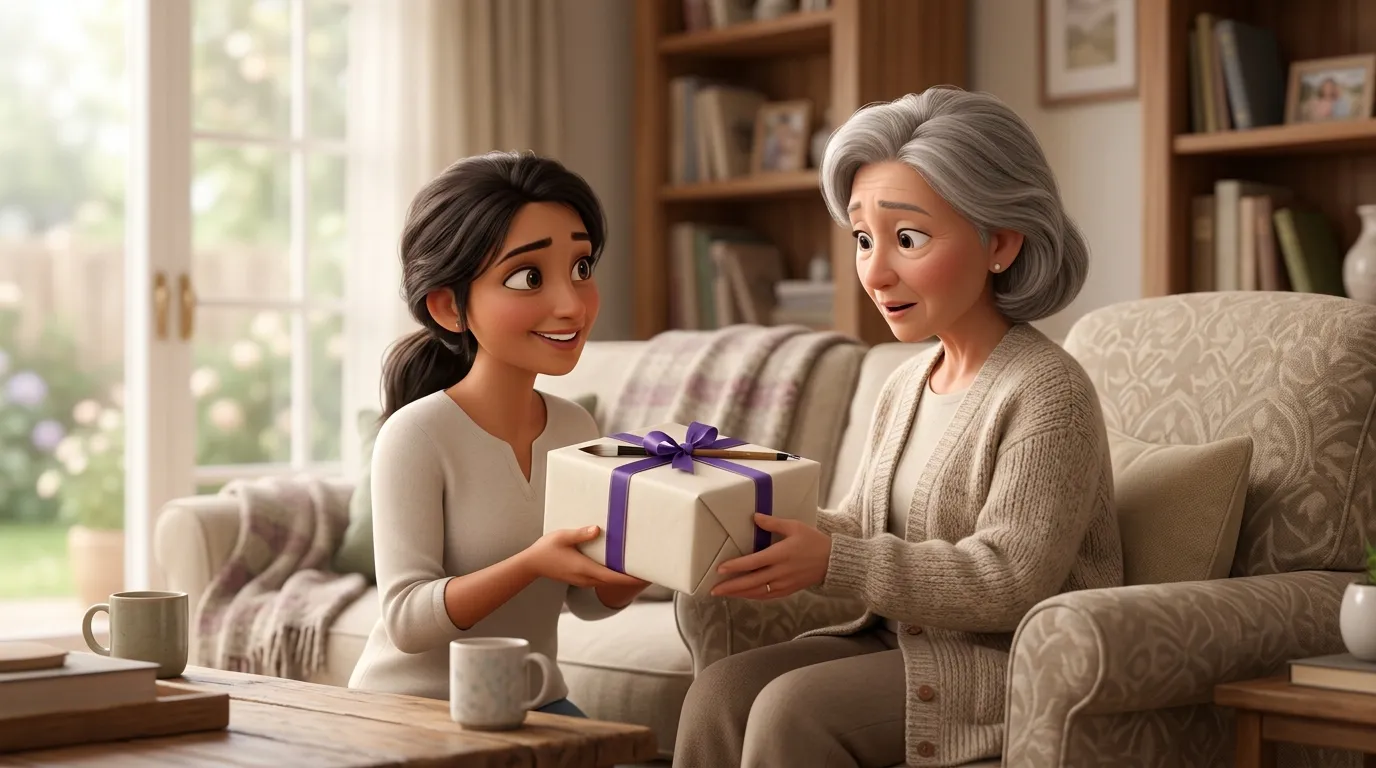
Mira opened the calligraphy set first. She lifted the lid, removed one of the nibs, and held it up toward the window the way she used to hold up students' lab vials against the light.
"Japanese nibs."
"Is that good?"
"Yes." She set it down with the care of someone who would be using it this week. "It's good."
The frame she opened more carefully. Priya's handwriting looked, in a white mat with a proper frame around it, exactly as bad as it always had — a slight backward lean, letter spacing with its own opinions, the P that had been arguing with itself since approximately age eight. Mira studied it.
"Your handwriting is horrible."
"I know."
"It always has been."
"I know."
She set the frame against the lamp on the side table, not back in the box. Priya noted this.
There was no speech. No declared feeling. Mira moved to the kitchen to put the kettle on and asked if Priya wanted chai, which in thirty years of data collection Priya had learned to read as you did well.
She called her dad on the drive home.
"Your handwriting is horrible," he said, before she'd gotten to that part.
"She texted you."
"The second you left."
Ripple Effect
The frame was on the wall when Priya visited in October.
Not a prominent wall — the small hallway between the kitchen and the guest room, the one that had been accumulating family photos since about 1987. It was between a picture from her parents' first year in Canada and Priya's school photo at nine, missing a tooth, wearing a sweater that had been returned approximately two weeks after that photo was taken.
Priya stood in the hallway and looked at it.
"I could get something printed with better typography," she called toward the kitchen.
"Don't you dare," her mother called back.
The Wednesday calligraphy class was still running. Gerald had graduated to ornate lettering on cards he was making by hand. Mira had moved into a second workbook and discovered a Sumi ink she preferred, which she'd researched, ordered online, and demonstrated to Priya with the efficiency of a chemistry teacher who has found the superior reagent.
Priya asked about the practice sheets at some point during the visit. Asked what Mira worked on when she was just drilling.
Mira went to the kitchen drawer and came back with a folder.
Six weeks of practice sheets, neat as lesson plans. Mira had been working through different scripts, different weights, different ink loads. Every third page or so: names. Family names.
Priya was on maybe forty of those pages. Different scripts, different weights, the same name practiced over and over in ink that dried a slightly different shade depending on the humidity that morning. Her mother had been sitting at the kitchen table on Wednesday afternoons, learning something from the beginning, and practicing it on the names of people she loved.
She hadn't mentioned it. She'd just done it.
Priya had three tabs open for Christmas gifts by the time the train pulled into Union Station.